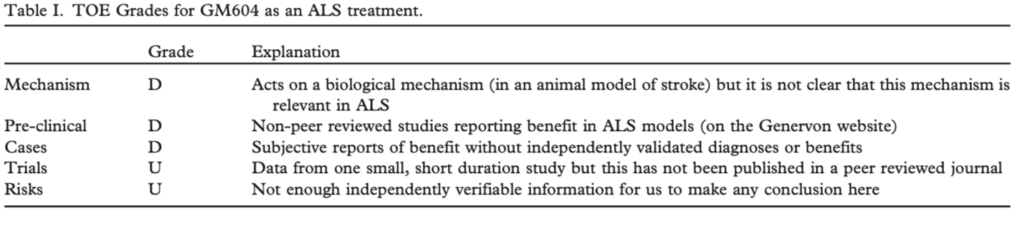
Since our last review we found a new paper suggesting that GM604 can modify the expression of a large number of genes in neuroblastoma cells
(Swindell et al. Translational Neurodegeneration (2018) 7:30). These cells are not a recognized pre-clinical model for ALS. The described genes have not been proven to influence human ALS progression. Our “Mechanisms” Grade therefore remains unchanged. We also found an Internet publication describing a case report and a very small (12 patient) clinical trial (F1000Research 2017, 6:230 Last updated: 17 JUL 2018). The case report suggested benefits from GM604 treatment in 1 person with ALS, but no validated objective ALS outcome measures were described. We therefore cannot change our current “Cases” grade. The trial compared 2 weeks of treatment with GM604 to placebo, with a total of 12 weeks of follow up. No statistically significant differences in ALSFRS-R, FVC, TGUG, grip strength or HHD scores were observed between these groups at week 12. The authors of this paper, (one of whom is an executive at the company that sponsored the trial) state that the GM604 treated group progressed more slowly than a historical control group, but it is not clear to us that the historical controls were adequately matched with regard to baseline prognostic factors. A post-hoc subgroup analysis was said to show benefits of GM604 treatment on FVC for the 4 patients at one of the 2 sites. It is not clear to us that this is a scientifically valid subgroup. Multiple “biomarkers” changed in response to GM604 treatment, but it is not clear to us that any of these are a useful way to measure ALS progression. Based on this one publication, we change our “Trials” grade to F. We note that this trial was underpowered and probably too short to detect modest changes in the clinical outcomes selected. Safety and tolerability were said to be good in the participants in this trial but we feel this is too small a number and too short an exposure to change our “Risks” grade. Our overall conclusion remains unchanged. We hope to see more data on GM604 in patients with ALS. Until this arrives and confirms benefits and safety, we cannot endorse this as an ALS treatment.
At this time ALSUntangled finds no independently verifiable data supporting the efficacy or even the safety of GM604 in patients with ALS. We believe that independent peer review and replication are fundamentals of good science (36,37). Accordingly, we share the FDA’s April 2015 opinion that the data on GM604 in ALS should be released now for
independent peer review (38). If these preliminary data are confirmed to be positive, statistics on the false-positive rate of small trials (29,30) and consensus ALS trial guidelines (35) dictate that they be replicated in a larger, longer duration study before GM604 is deemed effective or even safe for patients with ALS.
ALSUntangled generally supports the use of expanded access programs during ALS drug development. We believe that these should be reserved for treatments that have at least some independently verifiable safety data. In our opinion, that is not the case with GM604, so we feel that expanded access is premature at this time. When we can independently verify safety data, we hope to see a GM604 group expanded access program that has transparent entry criteria, systematic objective outcome measures, full disclosure of results, and, as suggested by the FDA, allows for a sponsor’s cost recovery but not for profit (39).
Grade A: Shown in a peer-reviewed publication to act on a relevant mechanism in humans
Mechanistic plausibility
Grade B: Shown in a peer-reviewed publication to act on a relevant mechanism in pre-clinical model(s)
Mechanistic plausibility - C
Grade C: Theoretically and plausibly acts on an ALS-relevant mechanism in humans
Mechanistic plausibility
Grade D: Acts on a biological mechanism but it is not clear that this mechanism is relevant in ALS
Mechanistic plausibility
Grade F: Implausible; would violate known principles or laws of biology
Mechanistic plausibility
Grade U: No useful information was found for this category
Pre-clinical models (animal or cell models recognized by ALSUntangled reviewers to be relevant to ALS)
Grade A: Two or more peer-reviewed publications reporting benefits in well-designed studies.
Animal studies are assumed to be ‘well designed’ when they follow published guidelines. When they deviate from these they are considered ‘flawed’.
Pre-clinical models (animal or cell models recognized by ALSUntangled reviewers to be relevant to ALS)
Grade B: One peer-reviewed publication reporting benefits in a well-designed study.
Animal studies are assumed to be ‘well designed’ when they follow published guidelines. When they deviate from these they are considered ‘flawed’.
Pre-clinical models (animal or cell models recognized by ALSUntangled reviewers to be relevant to ALS)
Grade C: One or more peer-reviewed publication(s) reporting benefits in flawed studies.
Animal studies are assumed to be ‘well designed’ when they follow published guidelines. When they deviate from these they are considered ‘flawed’.
Pre-clinical models (animal or cell models recognized by ALSUntangled reviewers to be relevant to ALS)
Grade D: One or more non-peer reviewed studies reporting benefits (published on a website or in an abstract)
Pre-clinical models (animal or cell models recognized by ALSUntangled reviewers to be relevant to ALS)
Grade F: The only studies available show no benefit
Pre-clinical models (animal or cell models recognized by ALSUntangled reviewers to be relevant to ALS)
Grade U: No useful information was found for this category
Patient case reports
Grade A: One or more peer-reviewed publications reporting benefits with validated diagnosis and benefits
Patient case reports
Grade B: More than one unpublished report of benefit with validated diagnosis and benefits
Patient case reports
Grade C: One unpublished report of benefit with validated diagnosis and benefits
Patient case reports
Grade D: Subjective report(s) of benefit without validated diagnoses and/or benefits
Patient case reports
Grade F: The only reports available show no benefit
Patient case reports
Grade U: No useful information was found for this category
Patient trials
Two or more peer-reviewed publications describing benefits in well-designed randomized, blinded placebo-controlled phase III trials
Patient trials
Grade C: One or more peer-reviewed publications reporting benefits in a well-designed randomized, blinded, placebo-controlled phase I or II trial
Patient trials
Grade D: One or more peer-reviewed publications reporting benefits in a flawed trial.
Flawed trials means those in which there are identifiable problems with patient selection, randomization, blinding, controls or follow-up. These have ‘high or unclear risk of bias’ according to published criteria. Well-designed trials are those that have ‘low risk of bias’.
Patient trials
Grade F: The only trials available show no benefit
Patient trials
Grade U: No useful information was found for this category
Risks (harms that occurred on this treatment)
Grade A: No exposed patients appear to have experienced harms
Risks (harms that occurred on this treatment)
Grade B: More than 0% but less than 10% of exposed patients experienced harms (no hospitalizations or deaths)
Risks (harms that occurred on this treatment)
Grade B (oral): More than 0% but less than10% of exposed patients experienced harms (no hospitalizations or deaths)
Grade D (intravenous): More than 0% but less than 5% of exposed patients experienced death or hospitalizations
Risks (harms that occurred on this treatment)
Grade C: At least 10% of exposed patients experienced harms (no hospitalizations or deaths)
Risks (harms that occurred on this treatment)
Grade D: More than 0% but less than 5% of exposed patients experienced death or hospitalizations
Risks (harms that occurred on this treatment)
Grade D: More than 0% but less than 5% of exposed patients experienced death or hospitalizations
Grade F: At least 5% of exposed patients experienced death or hospitalization
Risks (harms that occurred on this treatment)
Grade F: At least 5% of exposed patients experienced death or hospitalization
Risks (harms that occurred on this treatment)
Grade U: No useful information was found for this category