Mission & Methods
ALSUntangled® systematically reviews alternative and off label treatments (AOTs) to try and help patients with ALS make more informed decisions about them. The basic structure of all our reviews revolves around a “Table Of Evidence”. In this, each AOT is graded across 5 different categories: mechanistic plausibility, preclinical models, cases, trials and risks. Grades in each category range from A (best) to F (worst), with U meaning we could not find any useful disclosable evidence for the AOT in that category. Final grades are crowd-sourced across an international team of more than 100 clinicians and scientists from across 11 different countries.
Mission
There are many alternative and off label treatments (AOTs) advertised for ALS on the Internet. Internet information about AOTs is not always accurate. In order to help patients and families make more informed decisions about Internet AOTs, we started ALSUntangled® in 2009. This paper describes our original background and methodology.
A Scientific Approach to Off-Label Treatment Options for People with ALS Using Tweets and Twitters
Methods
To try and make our reviews as objective as possible, we created a structure called the Table of Evidence. Each AOT is examined across 5 different categories: Mechanistic Plausibility, Pre-Clinical, Cases, Trials and Risks. Within each category, we assign a letter grade based on the strength of the evidence we find. Grades range from A (best) to F (worst). We assign a grade of U when we cannot find any useful disclosable information for an AOT in a particular category.
ALSUntangled®: Introducing the Table of Evidence
Listen to a podcast that explains our background, purpose, and methods
Listen to “ALSUntangled Series: Ep. 1 – ALSUntangled untangled” on Spreaker.Ten Red Flags
To try and help patients considering AOTs we have not reviewed, we applied our experience from years of training, caring for PALS, and ALSUntangled® writings to construct and crowd-source a list of 10 things to be wary of. In our opinion, all of the things on this list are problematic, and they tend to be associated with treatments we assigned lower grades to. The more of these “ten red flags” patients find associated with an AOT, the more wary we think they should be.
ALSUntangled® 56: “ten red flags”-things to be wary of in alternative or off-label products
Listen to a podcast that further explains these red flags
Listen to “ALS Untangled Series: Ep. 28 – List of rotten eggs” on Spreaker.How We Update Older Reviews
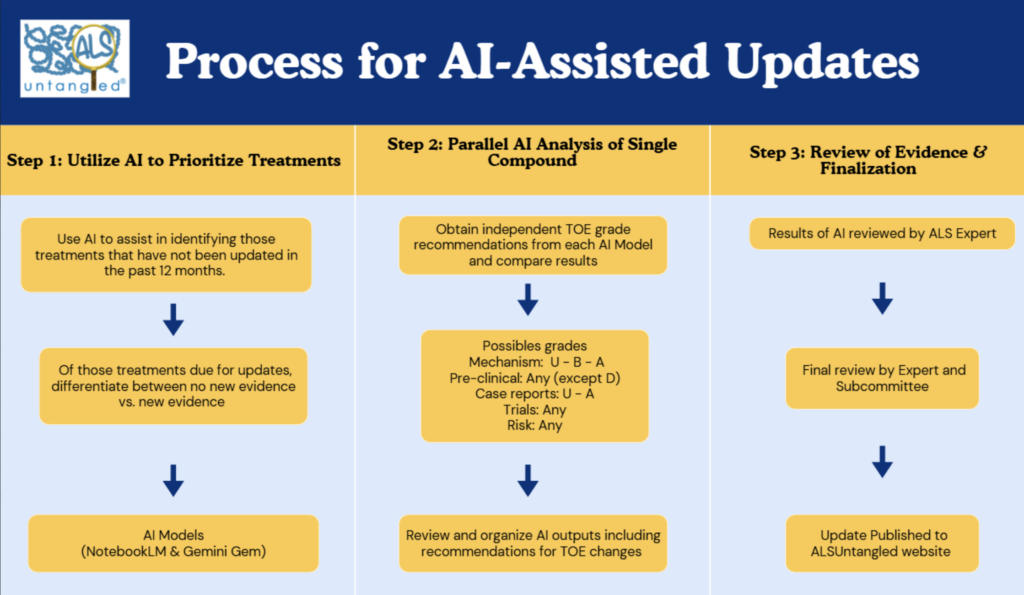
Use of Artificial Intelligence in ALSUntangled Reviews Updates (from 2026)
Since 2026, ALSUntangled has begun using artificial intelligence (AI) to help update previously published reviews. The purpose of using AI is to speed up the review process, not to replace expert judgment. AI is used to assist with tasks such as identifying new scientific articles, organizing information, and summarizing large amounts of data. This allows ALS experts to focus more time on carefully reviewing the evidence and discussing its clinical relevance. All conclusions published by ALSUntangled are reviewed and approved by human experts. AI does not make final decisions, assign grades, or provide recommendations on its own. In short, AI helps ALSUntangled work more efficiently, while expert oversight remains central to every review.