We found no new information on this product which would warrant any grade changes. The websites this was being advertised on no longer appear to be working. Our conclusion remains unchanged: ALSUntangled does not support the use of Mototab.
Updated July 24, 2023
As of July 2023 we found no new information that would warrant any TOE grade changes
Updated August 30, 2021
Since our review, we found no new information on Mototab. Our TOE Grades remain unchanged.
Given the lack of demonstrated effectiveness, and the above-documented concerns about product safety and supplier identity and reliability, ALSUntangled does not support the use of mototab
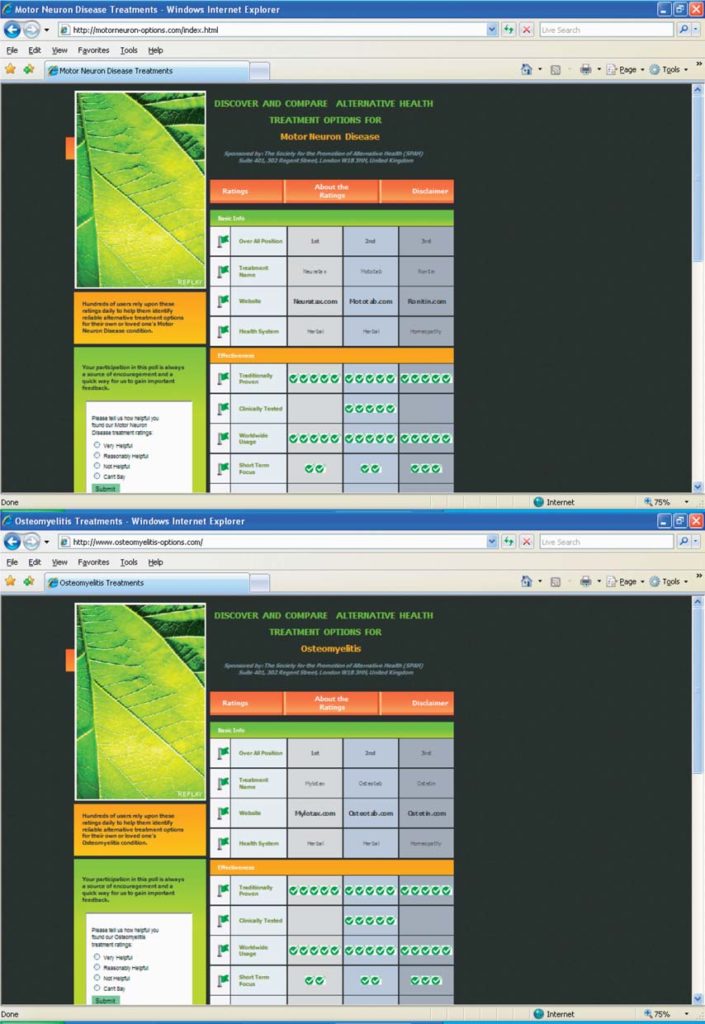
Figure 2. Remarkably similar websites of SPAH comparisons.
for amyotrophic lateral sclerosis or any other motor neuron disease. If Oslo Health Solutions ever con-tacts us with additional useful information on this product we will gladly publish an addendum to this investigation.
Mechanistic plausibility
Grade A: Shown in a peer-reviewed publication to act on a relevant mechanism in humans
Mechanistic plausibility
Grade B: Shown in a peer-reviewed publication to act on a relevant mechanism in pre-clinical model(s)
Mechanistic plausibility - C
Grade C: Theoretically and plausibly acts on an ALS-relevant mechanism in humans
Mechanistic plausibility
Grade D: Acts on a biological mechanism but it is not clear that this mechanism is relevant in ALS
Mechanistic plausibility
Grade F: Implausible; would violate known principles or laws of biology
Mechanistic plausibility
Grade U: No useful information was found for this category
Pre-clinical models (animal or cell models recognized by ALSUntangled reviewers to be relevant to ALS)
Grade A: Two or more peer-reviewed publications reporting benefits in well-designed studies.
Animal studies are assumed to be ‘well designed’ when they follow published guidelines. When they deviate from these they are considered ‘flawed’.
Pre-clinical models (animal or cell models recognized by ALSUntangled reviewers to be relevant to ALS)
Grade B: One peer-reviewed publication reporting benefits in a well-designed study.
Animal studies are assumed to be ‘well designed’ when they follow published guidelines. When they deviate from these they are considered ‘flawed’.
Pre-clinical models (animal or cell models recognized by ALSUntangled reviewers to be relevant to ALS)
Grade C: One or more peer-reviewed publication(s) reporting benefits in flawed studies.
Animal studies are assumed to be ‘well designed’ when they follow published guidelines. When they deviate from these they are considered ‘flawed’.
Pre-clinical models (animal or cell models recognized by ALSUntangled reviewers to be relevant to ALS)
Grade D: One or more non-peer reviewed studies reporting benefits (published on a website or in an abstract)
Pre-clinical models (animal or cell models recognized by ALSUntangled reviewers to be relevant to ALS)
Grade F: The only studies available show no benefit
Pre-clinical models (animal or cell models recognized by ALSUntangled reviewers to be relevant to ALS)
Grade U: No useful information was found for this category
Patient case reports
Grade A: One or more peer-reviewed publications reporting benefits with validated diagnosis and benefits
Patient case reports
Grade B: More than one unpublished report of benefit with validated diagnosis and benefits
Patient case reports
Grade C: One unpublished report of benefit with validated diagnosis and benefits
Patient case reports
Grade D: Subjective report(s) of benefit without validated diagnoses and/or benefits
Patient case reports
Grade F: The only reports available show no benefit
Patient case reports
Grade U: No useful information was found for this category
Patient trials
Two or more peer-reviewed publications describing benefits in well-designed randomized, blinded placebo-controlled phase III trials
Patient trials
Grade C: One or more peer-reviewed publications reporting benefits in a well-designed randomized, blinded, placebo-controlled phase I or II trial
Patient trials
Grade D: One or more peer-reviewed publications reporting benefits in a flawed trial.
Flawed trials means those in which there are identifiable problems with patient selection, randomization, blinding, controls or follow-up. These have ‘high or unclear risk of bias’ according to published criteria. Well-designed trials are those that have ‘low risk of bias’.
Patient trials
Grade F: The only trials available show no benefit
Patient trials
Grade U: No useful information was found for this category
Risks (harms that occurred on this treatment)
Grade A: No exposed patients appear to have experienced harms
Risks (harms that occurred on this treatment)
Grade B: More than 0% but less than 10% of exposed patients experienced harms (no hospitalizations or deaths)
Risks (harms that occurred on this treatment)
Grade B (oral): More than 0% but less than10% of exposed patients experienced harms (no hospitalizations or deaths)
Grade D (intravenous): More than 0% but less than 5% of exposed patients experienced death or hospitalizations
Risks (harms that occurred on this treatment)
Grade C: At least 10% of exposed patients experienced harms (no hospitalizations or deaths)
Risks (harms that occurred on this treatment)
Grade D: More than 0% but less than 5% of exposed patients experienced death or hospitalizations
Risks (harms that occurred on this treatment)
Grade D: More than 0% but less than 5% of exposed patients experienced death or hospitalizations
Grade F: At least 5% of exposed patients experienced death or hospitalization
Risks (harms that occurred on this treatment)
Grade F: At least 5% of exposed patients experienced death or hospitalization
Risks (harms that occurred on this treatment)
Grade U: No useful information was found for this category